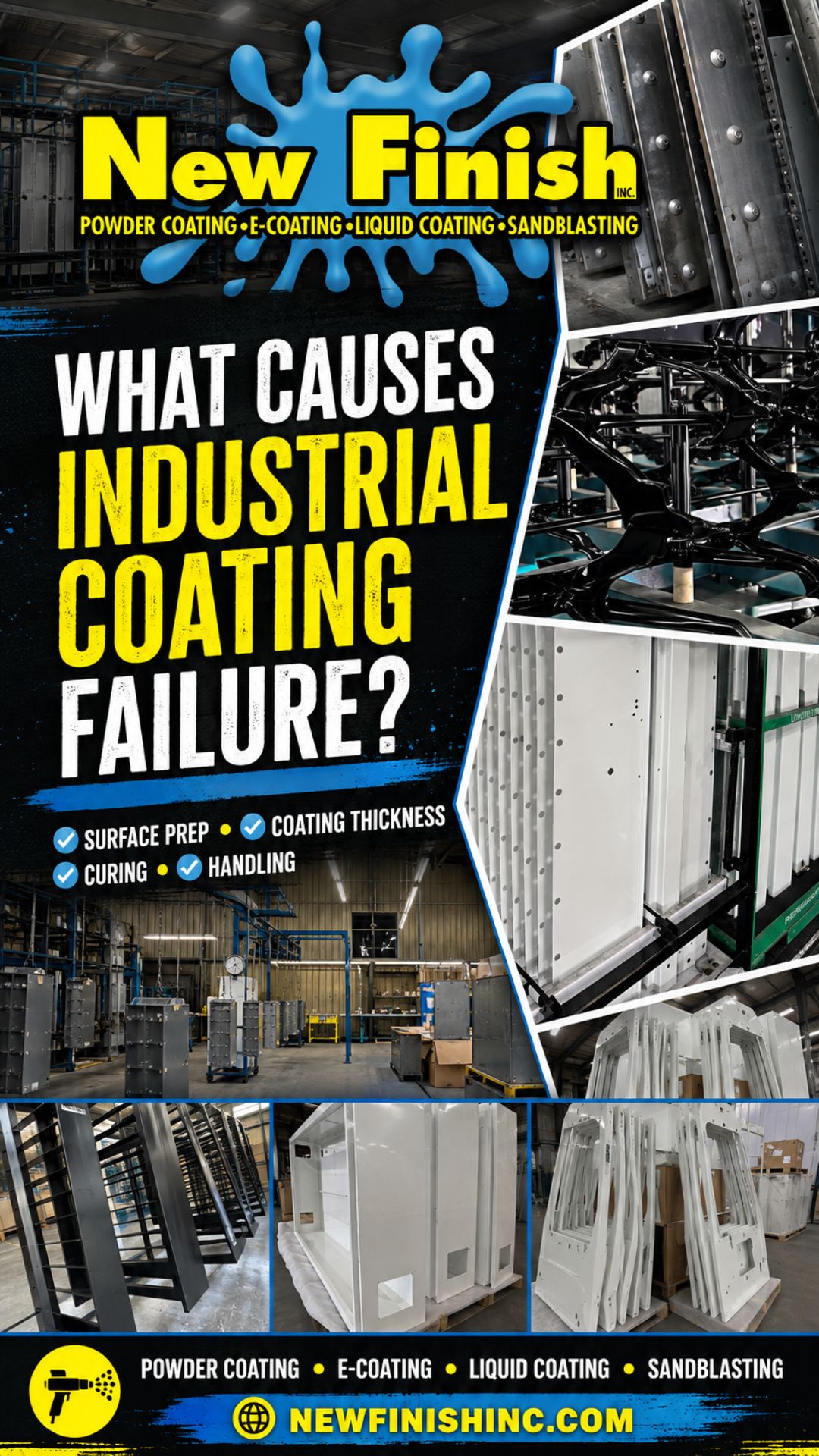
Industrial coatings are designed to protect metal components, improve appearance, resist corrosion, and help manufactured products perform in demanding environments. But even a high-quality coating can fail when important steps involving preparation, application, curing, handling, or coating selection are overlooked.
For manufacturers, industrial coating failure can create much larger problems than an unattractive finish. Peeling, blistering, poor adhesion, corrosion, uneven coverage, or premature wear can lead to rejected parts, rework, production delays, increased costs, and problems further down the assembly process.
Understanding why coatings fail can help manufacturers reduce these risks and select an experienced industrial coating partner capable of supporting consistent production requirements.
Inadequate Surface Preparation
One of the most important factors in coating performance is what happens before the coating is ever applied. Dirt, oil, rust, mill scale, oxidation, previous coatings, and other contaminants can interfere with adhesion.
Proper surface preparation for industrial coating may include cleaning, sandblasting, chemical treatment, or other pretreatment processes depending on the substrate and coating specification.
If contaminants remain on the surface, the coating may initially appear acceptable but later begin lifting, peeling, blistering, or allowing corrosion to develop underneath the finish.
Incorrect Coating Thickness
Applying more coating does not automatically create better protection. Industrial coatings are normally designed to perform within specified thickness ranges.
A coating that is too thin may not provide adequate coverage or corrosion protection, while excessive coating thickness can contribute to curing problems, cracking, dimensional issues, or difficulties with assembly. Understanding the importance of industrial coating thickness and mil specifications is particularly important when manufacturers have tight tolerances or repeat-production requirements.
Improper Curing
Curing is another critical part of coating performance. Powder coatings, liquid coatings, and other finishing systems have specific temperature, time, and process requirements.
When a coating is under-cured or otherwise processed incorrectly, it may not achieve its intended hardness, adhesion, chemical resistance, or durability. Consistent application and curing are therefore an important part of overall industrial coating quality control.
Using the Wrong Coating for the Application
Different metal parts face different operating conditions. Some require corrosion resistance, while others may need chemical resistance, appearance standards, weather protection, abrasion resistance, or specialized performance.
Selecting between industrial powder coating, e-coating, and liquid coating should be based on the part, substrate, operating environment, appearance requirements, and manufacturing specifications—not simply on choosing one process for every application.
Masking and Part Tolerance Problems
Threads, electrical contacts, mating surfaces, bearing locations, holes, and other critical areas may need to remain coating-free. When these areas are not properly protected, coating buildup can interfere with assembly or part function.
Professional industrial masking services help protect critical dimensions and ensure coatings are applied only where required.
Handling and Communication Matter Too
Even a properly coated part can be damaged through improper handling, packaging, storage, or transportation. Clear communication about part specifications, coating requirements, masking, quantities, packaging, and production schedules can help prevent problems before production begins.
New Finish, Inc. works with manufacturers across North Carolina, South Carolina, and Virginia requiring dependable industrial finishing support for metal components. With capabilities that include powder coating, e-coating, liquid coating, CARC, masking, sandblasting, surface preparation, and production support, New Finish helps manufacturers focus on consistent results from preparation through final finish.
If your company is experiencing coating problems, evaluating a new finishing process, or preparing a new production project, contact New Finish, Inc. to discuss your industrial coating requirements.