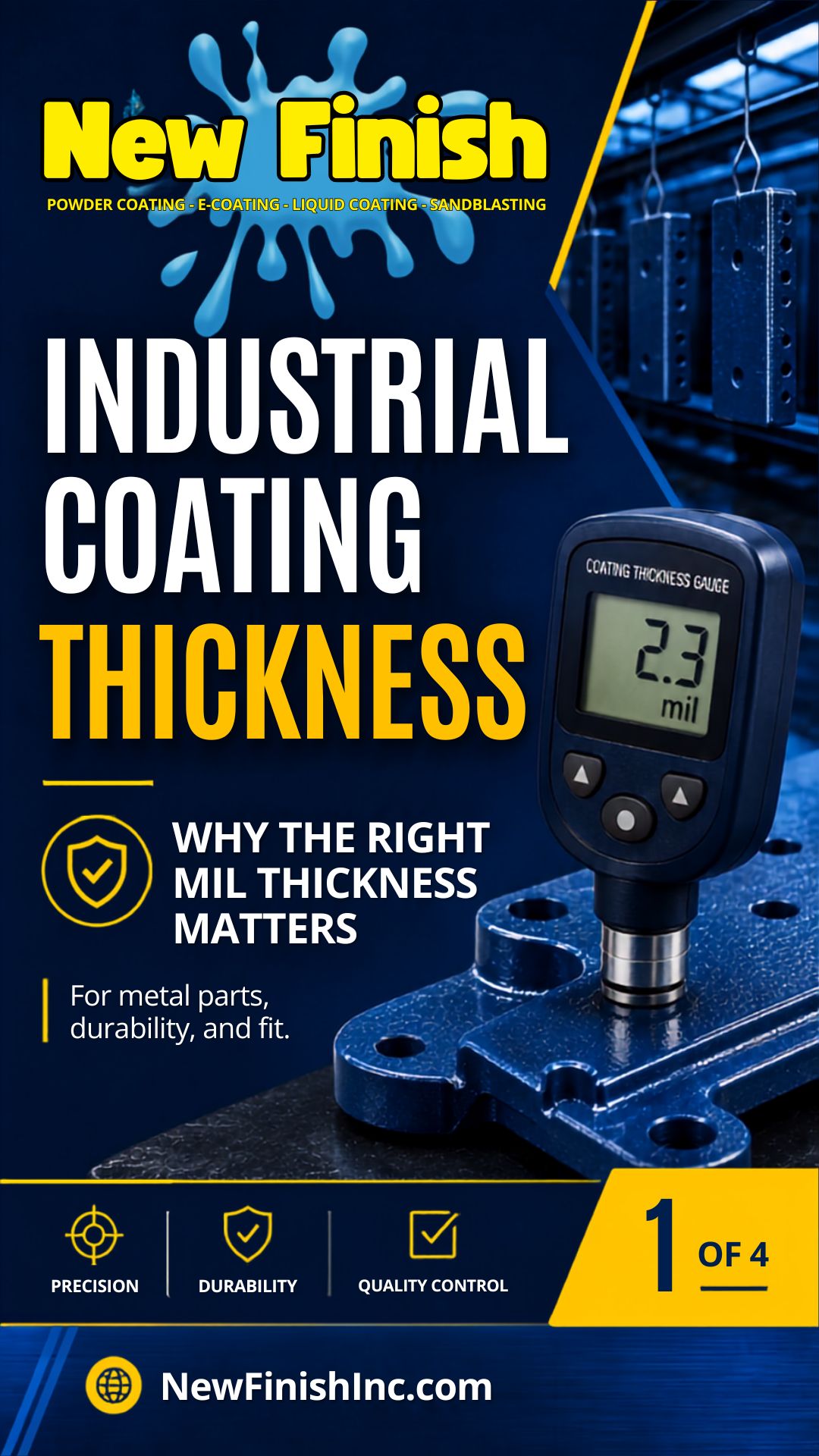
Industrial Coating Thickness: Why the Right Mil Thickness Matters for Metal Parts
Industrial coating performance depends on more than selecting the right coating material. The thickness of the applied coating can influence corrosion resistance, durability, appearance, curing, part tolerances, and long-term performance. For manufacturers, understanding industrial coating thickness can help prevent premature coating failure and ensure finished parts meet project requirements.
At New Finish, Inc., coating thickness is considered alongside industrial metal coating requirements, surface condition, part design, operating environment, and manufacturer specifications. Whether a project requires powder coating, e-coating, liquid coating, or CARC coating, consistent application is essential.
What Is Industrial Coating Thickness?
Industrial coating thickness is often measured in mils. One mil equals one-thousandth of an inch. Although that measurement may seem small, even slight variations can affect how a coated part looks, fits, and performs.
The appropriate coating thickness depends on the coating system, substrate, part geometry, intended use, and applicable specification. There is no single thickness that works for every metal part or industrial application. Manufacturers should provide coating specifications, drawings, masking requirements, and performance expectations whenever possible.
Why the Correct Coating Thickness Matters
A properly applied coating creates a protective barrier between the metal substrate and moisture, chemicals, abrasion, weather, and other damaging conditions. When the coating reaches the required thickness, it can provide more reliable coverage and support the expected service life of the finished component.
Correct thickness can also support:
- Consistent corrosion protection
- Uniform color and appearance
- Proper curing and adhesion
- Resistance to chips, scratches, and wear
- Accurate fit between assembled parts
- Compliance with customer or project specifications
Coating thickness should be treated as part of the overall quality process, not simply as a cosmetic consideration.
What Happens When a Coating Is Too Thin?
A coating that is too thin may not provide adequate protection. Thin or inconsistent areas can leave edges, corners, welds, and other surfaces more vulnerable to corrosion and wear.
Insufficient coating thickness may contribute to early rust, uneven appearance, reduced chemical resistance, incomplete coverage, or premature coating failure. These problems can become especially costly when parts must be stripped, recoated, or replaced.
Proper surface preparation and sandblasting are also important because coating thickness alone cannot compensate for rust, oil, scale, or contamination beneath the finish.
What Happens When a Coating Is Too Thick?
More coating is not always better. Excessive thickness can create its own performance and production problems. Depending on the coating system, a finish that is too thick may cure improperly, crack, chip, sag, run, or develop an inconsistent appearance.
Excess coating can also interfere with threads, holes, electrical grounding points, hinges, fasteners, and mating surfaces. This is why professional industrial masking services are important for parts with tight dimensional tolerances or areas that must remain coating-free.
Wet-Film Thickness vs. Dry-Film Thickness
Liquid coatings may be evaluated by both wet-film thickness and dry-film thickness. Wet-film thickness refers to the coating immediately after application, before solvents or other components evaporate. Dry-film thickness refers to the final thickness after the coating has dried or cured.
Because liquid coatings change during drying and curing, the original wet measurement and final dry measurement will not necessarily be the same. The coating product, solids content, application method, and curing process all affect the final result.
Thickness Varies by Coating Process
Different industrial coating systems achieve protection in different ways. Powder coating provides a durable finish for many industrial components. E-coating uses an immersion and electrical deposition process that can provide uniform coverage across complex parts. Liquid coating may be selected when a wet-applied finish, specialized appearance, or particular performance characteristic is required.
Military and defense-related components may require CARC coating applied according to specific coating-system and performance requirements. The proper thickness must be determined by the applicable product data, project specifications, and intended use.
Precision Industrial Coating Across NC, SC, and VA
New Finish, Inc. provides industrial coating support for manufacturers requiring dependable preparation, masking, application, inspection, and finishing. With multiple coating capabilities and experience handling demanding industrial parts, our team helps customers choose a process suited to their materials, performance requirements, and production needs.
Manufacturers across North Carolina, South Carolina, and Virginia can rely on New Finish, Inc. for powder coating, e-coating, liquid coating, CARC coating, masking, sandblasting, and other industrial finishing services.
Need help evaluating coating requirements for your metal parts? Contact New Finish, Inc. to discuss your industrial coating project.