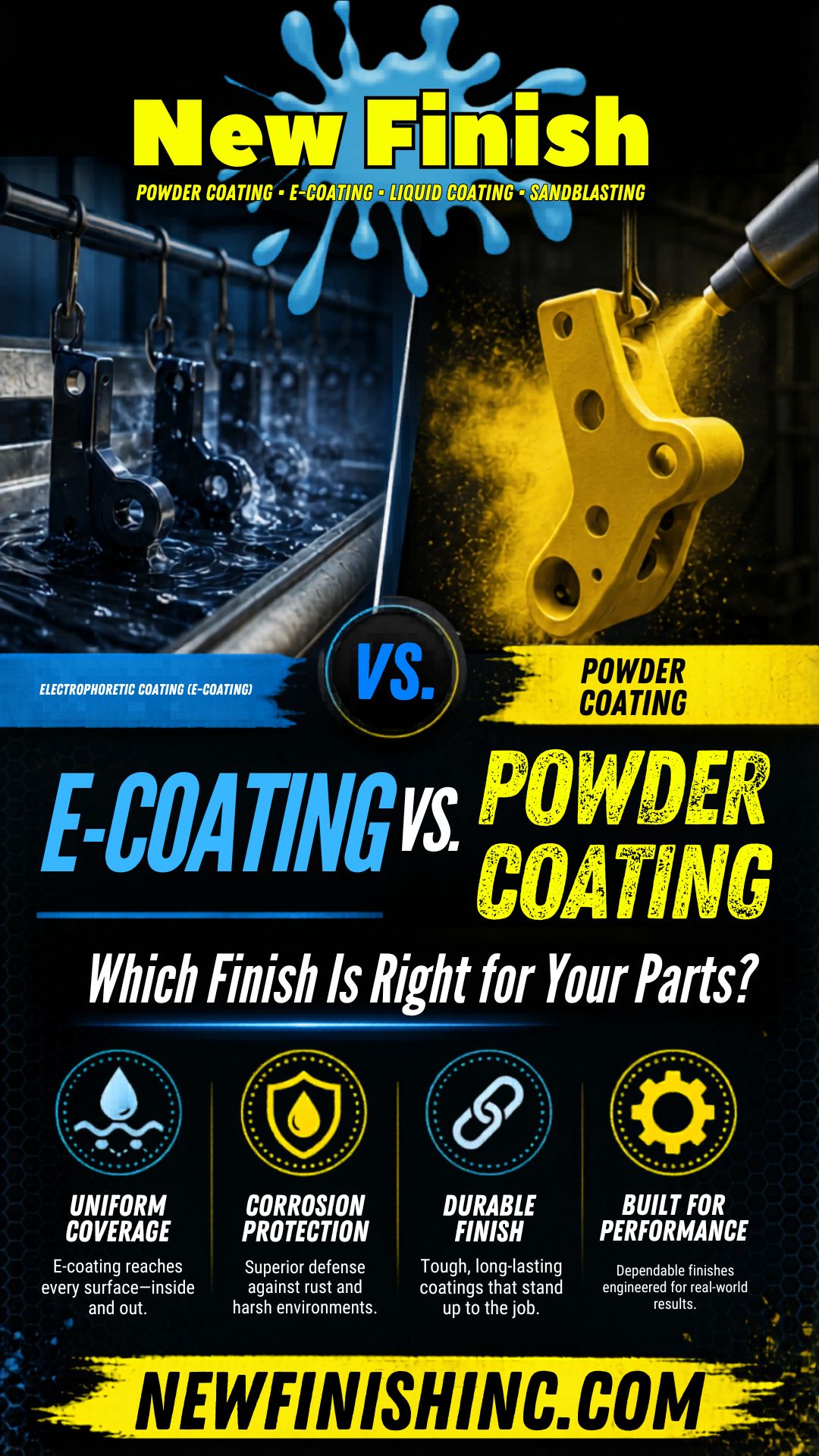
Choosing the right coating process is an important decision for manufacturers that need durability, corrosion protection, consistency, and long-term performance. Two common industrial finishing options are electrophoretic coating and powder coating. Both can protect metal parts, improve appearance, and support demanding manufacturing needs, but they are not the same process.
At New Finish, Inc., manufacturers across North Carolina, South Carolina, and Virginia rely on professional industrial coating services to help match the right finish to the right application. Understanding the difference between electrophoretic coating and powder coating can help your team make a more informed decision before sending parts into production.
What Is Electrophoretic Coating?
Electrophoretic coating, often called e-coating or electrocoating, is a process that uses electrical current to apply coating evenly to metal parts. During the process, parts are submerged in a coating bath, and the electrical charge helps draw the coating to the metal surface.
One of the biggest advantages of e-coating services is the ability to provide consistent coverage, even on complex shapes, recessed areas, corners, edges, and hard-to-reach surfaces. For parts with detailed geometry or areas that may be difficult to coat evenly with other methods, electrophoretic coating can be a strong option.
E-coating is commonly chosen for corrosion resistance, uniform film build, and dependable coverage. It is often used for automotive parts, industrial components, metal assemblies, and parts that need a protective base coating before additional finishing.
What Is Powder Coating?
Powder coating is a dry finishing process where finely ground powder is applied to metal parts and then cured with heat. During curing, the powder melts and forms a durable, protective finish.
Powder coating is known for its strength, appearance, durability, and resistance to chipping, scratching, and corrosion. It is often used when manufacturers want a tough finish that also provides a clean, professional appearance. Powder coating can be a good choice for heavy equipment parts, industrial products, automotive components, recreational parts, and large metal assemblies.
For many manufacturers, industrial powder coating is selected because it offers a strong finish and can be customized for different performance and appearance requirements.
How the Two Processes Compare
The best coating choice depends on the part, the environment, the required protection, and the final performance expectations.
Electrophoretic coating is often preferred when uniform coverage is critical. Because parts are immersed in the coating bath, e-coating can reach areas that may be more difficult to coat evenly with spray-applied finishes. This makes it useful for parts with seams, cavities, recessed areas, and complicated shapes.
Powder coating is often preferred when a thicker, highly durable exterior finish is needed. It provides strong surface protection and is often selected for parts that need both performance and visual appeal.
In some cases, e-coating and powder coating may even work together. E-coating may be used as a corrosion-resistant base layer, while powder coating may be added as a topcoat for additional durability, color, and appearance.
Surface Preparation Still Matters
No coating process can perform at its best without proper surface preparation. Before electrophoretic coating or powder coating is applied, the metal surface must be prepared correctly. Dirt, rust, oil, old coating, scale, and other contaminants can affect adhesion and long-term performance.
That is why surface preparation for coating, cleaning, pretreatment, and industrial sandblasting are such important parts of the coating process. A durable finish starts before the coating is ever applied.
New Finish, Inc. offers industrial sandblasting, masking, powder coating, e-coating, liquid coating, CARC coating, and delivery services to support manufacturers with a more complete industrial finishing solution.
Which Finish Is Right for Your Parts?
If your parts have complex shapes, recessed areas, or require consistent corrosion-resistant coverage, electrophoretic coating may be the right choice. If your parts need a strong, durable, attractive exterior finish, powder coating may be the better fit.
The best answer depends on the part design, performance requirements, exposure conditions, production needs, and coating specifications. Working with an experienced industrial metal coatings partner can help manufacturers avoid coating failures, improve consistency, and choose a finish designed for long-term performance.
For manufacturers across NC, SC, and VA, New Finish, Inc. provides dependable industrial coating solutions built around quality, durability, and precision.
Contact New Finish, Inc. today to discuss your next project and choose the right coating process for your parts.