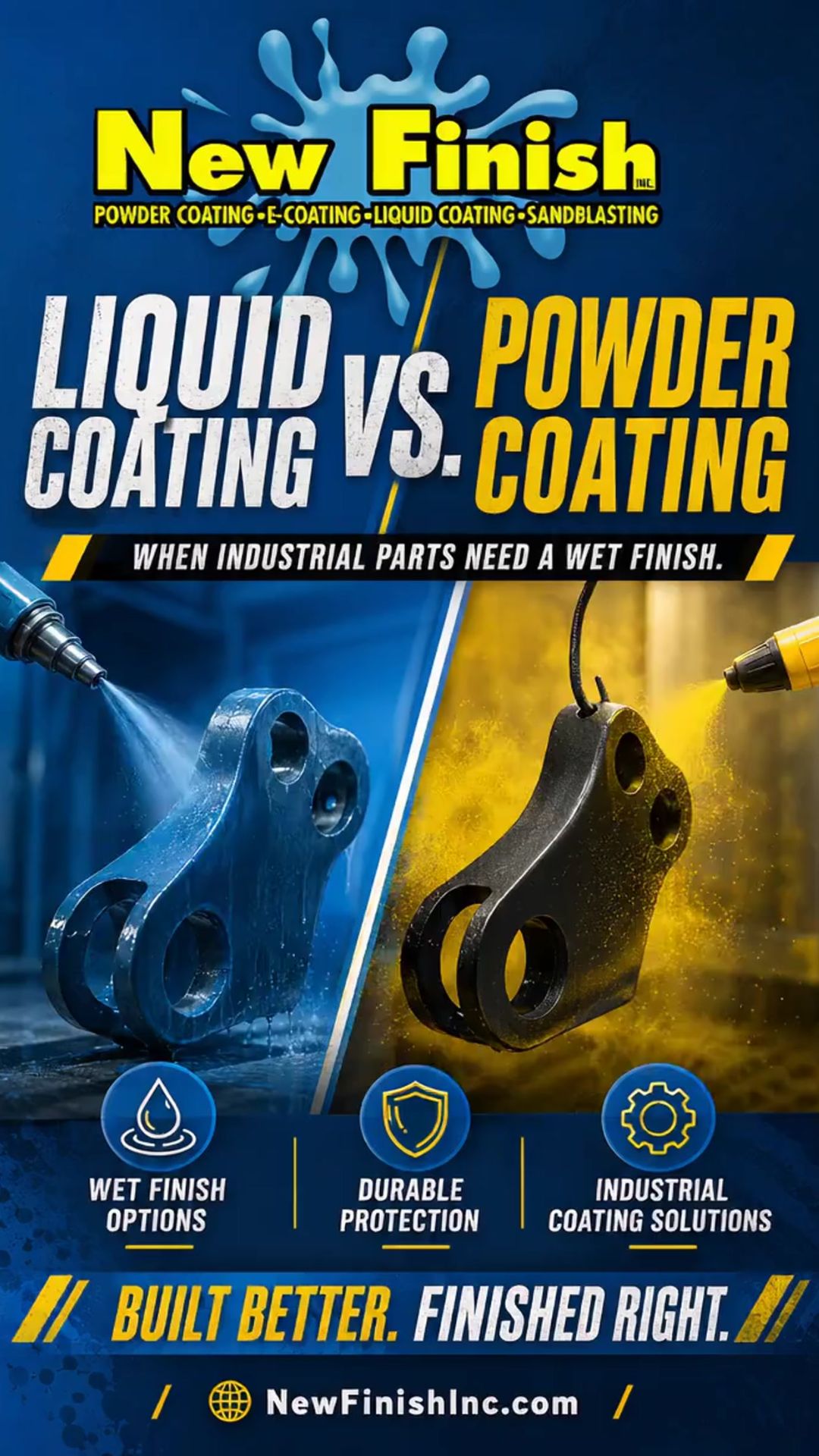
When manufacturers need a durable finish for metal parts, two common options are liquid coating and powder coating. Both can provide protection, improve appearance, and support long-term performance, but they are not always used for the same types of parts or production needs.
At New Finish, Inc., manufacturers across North Carolina, South Carolina, and Virginia rely on experienced industrial coating services to help determine which coating process is best for their parts. In some cases, powder coating is the right solution. In others, liquid coating may be the better choice because of part design, coating specifications, material requirements, or finish expectations.
What Is Liquid Coating?
Liquid coating is a wet finishing process where coating material is applied to a metal surface in liquid form. Depending on the part and project requirements, liquid coating may be used for corrosion protection, appearance, chemical resistance, durability, or specification-driven performance.
One of the advantages of liquid coating is flexibility. It can be a strong option for parts that need a specific finish, a thinner film build, custom coating requirements, or application in areas where powder coating may not be the best fit. Liquid coating may also be selected when parts are too heat-sensitive for certain powder coating cure requirements or when a project calls for a coating system that must be spray-applied.
For many industrial applications, liquid coatings help provide a smooth, protective finish while meeting the performance needs of manufacturers.
What Is Powder Coating?
Powder coating is a dry finishing process where powder is applied to a metal part and then cured with heat. During the curing process, the powder melts and forms a strong, durable protective finish.
Powder coating is often chosen for its durability, appearance, corrosion resistance, and efficiency. It is commonly used for industrial parts, heavy equipment components, automotive parts, recreational equipment, large trucking parts, and metal products that need a tough exterior finish.
For parts that can withstand the curing process and require a durable surface coating, industrial powder coating can be an excellent choice.
When Liquid Coating May Be the Better Choice
Although powder coating is a strong option for many applications, liquid coating can offer important advantages in specific situations. A wet finish may be better suited for parts with unique coating specifications, materials that cannot tolerate high heat, or components that require a specialized coating system.
Liquid coating may also be preferred when parts need a particular appearance, gloss level, texture, or performance characteristic that is better achieved through a spray-applied coating. For some projects, the part geometry, production requirements, or coating thickness needs may make liquid coating the more practical option.
That is why choosing the right coating process should never be based on one factor alone. The part design, material, environment, performance expectations, and coating specifications all matter.
Surface Preparation Still Comes First
No matter which coating process is selected, proper preparation is essential. A coating can only perform well when the surface underneath is properly cleaned, prepared, and inspected.
Before liquid coating or powder coating is applied, the metal surface may need cleaning, pretreatment, rust removal, old coating removal, or surface preparation for coating. In many cases, industrial sandblasting helps remove contaminants and create a surface profile that supports adhesion.
Surface preparation helps reduce the risk of peeling, blistering, uneven coverage, corrosion, and premature coating failure. A strong finish starts before the coating is ever applied.
Masking and Process Control
Some industrial parts also require masking before coating. Threads, openings, machined surfaces, bearing areas, contact points, and other precision areas may need to remain free of coating. Proper masking helps protect these critical areas while allowing the coating to be applied where it belongs.
Whether the job calls for liquid coating, powder coating, e-coating, or CARC coating, process control matters. Every step, from preparation and masking to application and final inspection, helps support coating quality and long-term performance.
Choosing the Right Industrial Coating Partner
The best coating choice depends on the part, the environment, the finish requirements, and the way the part will be used. Some parts are best suited for powder coating. Others require liquid coating. In some cases, manufacturers may need multiple coating processes depending on their product line.
New Finish, Inc. provides liquid coating, powder coating, e-coating, CARC coating, masking, surface preparation, sandblasting, and delivery services for manufacturers across NC, SC, and VA. By working with one experienced coating partner, manufacturers can streamline projects and choose the right process for each part.
If your company needs liquid coating, powder coating, or another industrial finishing solution, contact New Finish, Inc. today to discuss your project and request a quote.
#NewFinishInc #LiquidCoating #PowderCoating #IndustrialCoatings #MetalCoatings #IndustrialFinishing #SurfacePreparation #IndustrialSandblasting #Masking #MetalFinishing #CorrosionProtection #Manufacturing #NCManufacturing #SCManufacturing #VAManufacturing